
Vestibular Rehab / Dizziness & Balance
Dizziness and feeling off balance often start in the inner ear or in how the brain reads signals from it, and vestibular rehabilitation is physical therapy that retrains that system. Joint Effort Physical Therapy provides vestibular therapy for dizziness, balance problems and walking changes in Hot Springs, Arkansas, and treats the closely related vertigo and BPPV too.
Your balance system, in plain language
Your vestibular system is a set of fluid-filled chambers and sensory nerves in the inner ear. It tells your brain where your head is and how it is moving, and your brain combines that with what your eyes see and what your joints sense to keep you steady.
When one part sends faulty signals, you can feel lightheaded, woozy, or as if you are swaying even when you stand still. Many people describe it as being unsteady on my feet, reaching for walls and railings, or simply not as steady as they used to be.
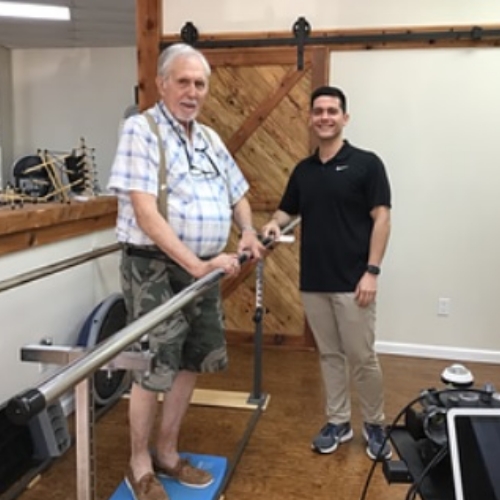
What can throw your balance off
The cause shapes the plan, so finding it is the first job of your evaluation.
Inner ear problems
Benign paroxysmal positional vertigo (BPPV), vestibular neuritis, labyrinthitis and Meniere’s disease all disturb the signals from the inner ear. BPPV has its own page: vertigo and BPPV.
Head injury
Dizziness and balance changes can follow a concussion. Our page on concussion rehab covers that recovery.
Nerve and brain conditions
Problems such as peripheral neuropathy, Parkinson’s disease and stroke recovery change the signals your brain receives from your feet, joints and muscles.
Aging and weakness
Reaction time, leg strength and joint position sense can all fade with age or after an illness or injury, and each one can make you feel less steady.
Balance and walking problems are linked
Our physical therapist looks at balance and gait together. A balance problem is partly physical, because joint strength, mobility and the ability to sense where your joints are in space all affect how steady you are. It is also partly the brain, which may believe you are moving when you are not.
A gait problem shows up in how you walk. Pain in a hip or knee, weakness after an injury, or a neurological condition can change your steps, and those changes can become more pronounced with age. If hip, knee or other joint pain is part of why you walk unsteadily, we treat that as well.
What your evaluation looks at
Balance and stance
How steady you are standing, turning and changing surfaces or positions, alongside your medical history and symptoms.
Eye movements and head position
Testing how your eyes and inner ear work together, and which head movements bring on dizziness.
Gait analysis
We watch how you walk to find where your steps, strength or joint motion are working against your balance.
Retraining the brain and inner ear to work together
Vestibular rehabilitation works through adaptation and compensation: with practice, your brain learns to use the signals it gets, and to lean on your eyes and body sense, so that you regain stability. Your plan is personalized, and may include:
- Gaze stabilization exercises that keep your vision clear while your head moves
- Habituation exercises that gradually reduce the dizzy feeling certain movements cause
- Balance training and gait retraining so you learn safer ways to stand and walk
- Strengthening and stretching for the muscles and joints that support you
- The Epley maneuver, when your dizziness comes from BPPV
Gentle therapeutic exercise and neuromuscular re-education often round out the plan, and geriatric therapy is part of the picture for older adults.
Fall prevention and fear of falling
Feeling unsteady can make you cut back on walking, errands and stairs, and that can leave you weaker and less safe. Fear of falling is a real symptom, and building leg strength, reaction speed and confidence in a supervised setting is a core part of balance therapy, and many people search for balance therapy near me only after a scare. Fall prevention is a common reason people come to see us, and it is a good reason to ask for an evaluation before a fall happens.
Go to the ER or call 911 if dizziness comes with
Dizziness can occasionally signal a stroke or another emergency. Do not wait for a therapy appointment if you have:
- Sudden dizziness with slurred speech
- Drooping on one side of the face
- Weakness or numbness in an arm or leg
- A sudden, severe headache
Not sure whether your plan needs a referral? Call us. As a courtesy, we verify your health benefits before you arrive.
Related care
Dizziness and balance problems care in Hot Springs, Arkansas
Joint Effort Physical Therapy treats Dizziness and balance problems at our Hot Springs clinic, 1880 Airport Rd., Suite C. Our physical therapist and physical therapist assistants help you find your footing again.
Not sure whether your plan needs a referral? Call us. As a courtesy, we verify your health benefits before you arrive.
Meet the people who treat you on our team page.